University of Colorado Athletics
Woelk: Buffs Turnaround Result Of Steady Process
October 24, 2016 | Football, Neill Woelk
Coaches, players have stuck with the system
BOULDER — As the No. 23 Colorado Buffaloes continue to gain attention around the nation, the question that's being asked more and more frequently is this: "How did the Buffs turn it around so quickly? How did the team that won just one Pac-12 game in the last two seasons combined turn the page so quickly to become a legitimate conference contender?"
Short answer? They didn't.
The Buffs' turnaround didn't happen overnight.
Rather, people simply weren't paying close enough attention. While Mike MacIntyre, his staff and players saw the improvement and talked about the incremental progress over the last couple of years, most folks didn't take the time to listen.
But now, with a 6-2 overall record, a 4-1 Pac-12 mark and a No. 23 national ranking, the Buffs can't be ignored. They've been called "the most improved team in America" by veteran college football writers and they're getting national notice on a regular basis.
"We are a tougher, physical team than we have been," said MacIntyre, whose 6-2 Buffs (4-1 Pac-12) have a bye week before playing host to UCLA on Nov. 3 (7 p.m., Fox Sports 1). "That's been a process. It did not just happen this year. Every year we've gotten a little better at it. It all came into fruition this year with the maturity of the team and the guys that have played and understand it."
It has indeed been a process, one that began with MacIntyre's first recruiting class in 2013 and one that has continued at a steady pace since. It has required measuring progress in tiny increments at times and patience throughout. It has included coaching staff changes, player growth, and support from an administration when doubts from the outside grew loud.
It has also required a narrow focus from within, a sense of purpose from players and coaches who have taken the job of improving on a day-to-day basis. There has been precious little finger-pointing and loads of trust. Player development has been a cornerstone, as has been faith in the process. When criticism from the outside has been the loudest, resolve from within has been the strongest.
It's been a process of building a foundation piece by piece with players who have continued to believe in that process. They came in, they bought in and are now seeing some reward for their resiliency.
"No one left, no one quit on each other," said quarterback Sefo Liufau, a member of MacIntyre's first recruiting class in Boulder. "To go from one-and-something a couple years ago to 6-2 now, it means everything. It's a great accomplishment, but we're trying to go even further from here. We still have a lot left to accomplish."
Indeed, the Buffs believe their special season has just begun. Already bowl eligible for the first time since 2007, the Buffs have plenty remaining on their plate. With four regular season games to go, they still have the opportunity to win a Pac-12 South title and play for a conference championship.
So how did they get to this point? There have been a number of factors, all of which have come together to produce what has the chance to be a special season.
PLAYER DEVELOPMENT. This season has been a testament to the players who came to Colorado when the program was down and stayed through the adversity. They came to Boulder, played as youngsters and took their lumps — but instead of leaving, instead of seeking greener pastures, they stayed.
They are the players who have become difference makers. From Liufau to Phillip Lindsay, from Chidobe Awuzie to Tedric Thompson, from Jimmie Gilbert to Alex Kelley, Jeromy Irwin to Kenneth Olugbode, the players who played early and learned under fire are now the players who are producing plays that are winning games.
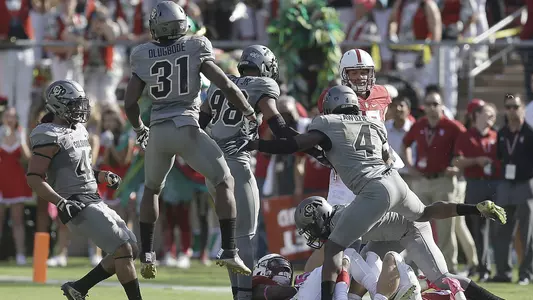
Saturday afternoon, after the Buffs had gritted out a 10-5 win over defending conference champion Stanford, MacIntyre called his players together in the locker room.
"We rose from the ashes," MacIntyre said. "You rose from the ashes. … It was down and out. You stand here when you had other options. You came here because you believe in each other, you believe in me. … Thank you."
The development of those players can't be overstated, and it's being noticed each week by opposing coaches. Two weeks ago, when Colorado dealt Arizona State a 40-16 defeat, ASU coach Todd Graham saw the same players on the field that his team had beaten 48-23 just a year earlier.
But while the names were the same, Graham saw much different results.
"Colorado has the same guys," Graham said. "That tells me (MacIntyre) has done a great job with them. They were the better team tonight, no excuses."
It's a process that has required patience. When that first class came to Boulder, they found little competition for starting jobs. Many of them were thrust into regular playing time because coaches had no other choice.
"When you come to a program, you're going to have to develop it," MacIntyre said. "We recruited extremely hard and we recruited good football players as you can see now, but when we signed them everybody was going, 'Who are those guys?'
"They had to get a little bit bigger and a little bit stronger and they had to play. How we were with them every day and in every facet is how you build a program."
COACHING STAFF DEVELOPMENT. Developing players doesn't just happen on its own. MacIntyre has also had to develop his coaching staff, and in his four years in Boulder, he's put together an outstanding group of assistants.
Two years ago, he brought in Jim Leavitt and Joe Tumpkin to shore up his defense. In two seasons, the two have helped turn the Buffs from one of the worst defenses in America into what is today a top-20 ranked unit.
Last winter, MacIntyre added Darrin Chiaverini to his staff. While the Buffs didn't completely revamp their offense, they did make some significant changes, particularly in the tempo. While people wondered whether co-coordinators would work, MacIntyre was confident the system would yield results. Today, the Buffs are one of the nation's top-20 offenses in yards per game.
There were other changes. MacIntyre moved Klayton Adams to the offensive line, and that unit has become a consistent strength. He brought Darian Hagan on as running backs coach, and his influence on Phillip Lindsay has been dramatic.
Neither did MacIntyre stop with on-the-field coaches. He brought in strength and conditioning coach Drew Wilson, who took the Buffs back to the basics. Wilson turned CU's offseason conditioning program from what players once viewed as a necessary evil into one they now see as an opportunity. The result has been perhaps the most significant offseason gains by the Buffs in MacIntyre's tenure.
And, MacIntyre built a recruiting staff that is helping CU put together what has all the early signs of a top-25 class.
PLAYING TOGETHER. One of the upsides of all those young players playing two and three years ago means they have been playing alongside each other for years. It means they have become cohesive units.
That secondary that's making plays every week? They've been together for a couple of years — and there are just enough youngsters in this year's group to guarantee that cohesion will carry forward. Same with the offensive line, same with the linebackers and the same in the offensive backfield.
"These guys are playing together," Leavitt said after Saturday's win. "They trust each other, they trust us. They know how to react and they know the guy next to them is going to make a play. Do we have a ton of great players? Maybe, maybe not. But I know we have a lot of guys who play well together and trust what we're trying to do."
One other interesting facet of this team? A lack of superstars on whom the team's success hinges.
Pick half the teams in the nation's top 25 and you'll find one or two players who make those teams tick — and without those players, those teams would be in trouble.
But the Buffs have a team of very good players at virtually every position, an interesting example of the sum perhaps being greater than the parts.
Ask yourself this: Who would be the Buffs' MVP today? The answer could be a half-dozen players — a testament to the process and to their resilience.
STICKING TO THE PLAN. Yes, it's been a process, a sometimes-painful one. For the last two seasons, the Buffs closed the gap, coming close — excruciatingly close — too many times to count. But they never strayed from the process. They never took shortcuts, never made excuses. They told us they were getting nearer and nearer to turning the corner, and when this season began, they quietly but confidently told us this was the year.
Now, they're embarked on a redemption tour of sorts, a week-by-week trip through a conference that has beaten them — but never beaten them into submission.
It's their turn.
"We are way too quick this day and age to jump on the backs of coaches when they're trying to build something," said Stanford coach David Shaw after last weekend's game. "You give someone an opportunity to build a program and you give them the time to do it. Mike MacIntyre has done that. Colorado's administration stuck with him and now you are starting to see the result."
Not that they are finished, not by a long shot. With four games to go, they know that their success thus far is still tenuous. As MacIntyre reminds them on a regular basis, they have not yet arrived. The journey is far from complete.
Next comes a matchup with UCLA, a team that has inflicted its own special brand of torture on the Buffs for the past two seasons. Two years ago the Bruins came to Boulder and took a 40-37 win in double overtime. Last year, they erased a 31-28 Colorado lead in the fourth quarter to take a 35-31 win.
Two games the Buffs knew they could have won, two games that got away.
Now, that Thursday night matchup is the only thing on the Buffs' minds. While the rest of us enjoy the luxury of studying the November schedule and playing "what if," the Buffs have one singular purpose.
They're not concerned about a bowl game. They aren't looking ahead to what the rest of the month might hold.
Instead, they want to go 1-0 next week. That's all the matters. Just like everything else that's whirled around them through the years, they'll ignore the outside noise and lean on their own resolve, their own resilience.
These Buffs still have plenty to prove. What they've accomplished so far is not all they set out to do.
They told the world a couple of months ago what that goal was. They want to play for a championship. They believe in the process, believe in their coaches and believe in each other.
The only difference now is they have created a few more believers along the way.
Contact: Neill.Woelk@Colorado.edu