Colorado University Athletics
Buffs Running Game Shifting Into High Gear
October 27, 2016 | Football, Neill Woelk
BOULDER — When the season began, this was going to be the year that Colorado's passing game was going to flex its muscles.
After all, the Buffs had a host of quality returning receivers, a veteran quarterback, an improved offensive line and the influence of co-offensive coordinator Darrin Chiaverini, who brought with him from Texas Tech some tenets of the Air Raid offense.
Thus far, mission accomplished. Overall, CU's pass attack is fourth in the league, averaging 279.8 yards per game, and the Buffs are second in pass efficiency. The No. 23 Buffs also have two of the top four ranked quarterbacks in the conference (Sefo Liufau is No. 3 in pass efficiency and Steven Montez is No. 4), two of league's the top 12 receivers in receptions per game (Devin Ross and Bryce Bobo) and three of the league's top 12 receivers in yards per game (Shay Fields, Ross and Bobo).
It's what CU's coaches and fans hoped to see from the passing game. It has helped produce 35.4 points per game, a number that if it holds will be the most by a CU team since the 1995 Buffs averaged 36.9 points per game.
But the biggest story on the offensive side of the ball for the Buffs — or at least maybe the most surprising?
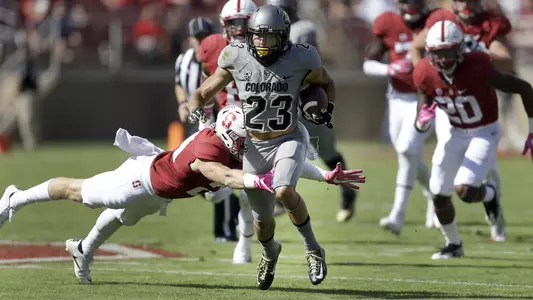
The Buffs are running the ball with an efficiency and effectiveness not seen in years at Colorado. In fact, if the Buffs continue at their current pace of 216 yards per game on the ground, they'll finish with 2,592 yards rushing — the most by any CU team since 2002, when Chris Brown and Bobby Purify teamed up to help CU rush for 3,136 yards.
Already, Colorado's 1,728 yards rushing this year is the third-best total in the last nine years. If they can match their season average in the next two games, it will be the most since that 2002 season, with two games still to go.
Has Colorado become the Ground Buffs?
"The misconception about what we do offensively is people think we always try to throw the football," Chiaverini said Thursday morning. "But what we really try to focus on is throwing the ball to open up the run game. If they jam up the box to stop our running game, fine. We'll throw it. But if they give us the opportunity to run, we're going to take it."
Improving CU's running game was one of head coach Mike MacIntyre's biggest priorities in the offseason, as the Buffs had finished 10th, 9th and 10th in the league in rushing offense in his first three years in Boulder. To address the issue, he did what may at first seem counter-intuitive: he brought in an offensive mind from a team known for its passing attack to help address CU's run deficiencies.
"That was the whole idea of the tweaks we made was to be able to run the ball better, be more precise in our passing game, be able to play a little bit faster and spread the field a little bit more horizontal to open up running lanes," MacIntyre said. "We knew our offensive line would be better if we stayed healthy, and we've stayed pretty much healthy. The guys have done well with our scheme and the offense knows it really well. They were good tweaks that we made to our offense."
Not that CU's passing game hasn't improved as well. The Buffs have added roughly 40 yards per game to their 2015 totals while also improving dramatically in their efficiency. Overall, CU's passing game has been as good as it has been in years.
But now it has a run game to go with it. CU's rushing attack is now fourth in the league (216 yards per game), with tailback Phillip Lindsay third in the Pac-12, averaging 93.1 yards per game and a robust 6.3 yards per carry.
Overall, it all adds up to the Buffs currently ranked as the second-most productive offense in the Pac-12 (and 18th in the nation), averaging 495.8 yards per game. Pair that with a defense that has made similar strides (CU is currently the Pac-12's No. 1 defense), and it's not hard to explain why the Buffs are 6-2 overall, 4-1 in the Pac-12 and currently ranked 23rd in the nation.
The offensive improvement in both areas begins with a much-improved offensive line. CU's veteran group has come together to take significant steps forward both in pass protection and in the run game.
"Coach (Klayton) Adams has done a great job with those guys," Chiaverini said. "They deserve a lot of credit for what we've been able to do."
But it's also come because of an up-tempo pace and what amounts to a "pick your poison" choice for defenses when the Buffs line up in their spread offense.
The philosophy is simple. The Buffs run a majority of their offensive sets with four wide receivers and one running back. When they start to throw quick passes to the wide receivers on the outside, it forces defenses to adjust and linebackers begin to cheat to the outside.
"If you get the ball on the perimeter to your receivers in space, those linebackers tend to start 'walking' out there," Chiaverini said. "Then you start to see a lot more five-man boxes — and that's what allows us to get our running back into space."
The result is that when a CU back — usually Lindsay — gets past the line of scrimmage, he has more room to run. Thanks to the Buffs' offensive line opening up big lanes, it gives Buffs' running backs a chance to make one-on-one plays against defenders in space.
"What we've been able to do is spread the field, play with tempo and get the ball out to our skill players," Chiaverini said. "That allows us to see some five-man boxes and allows our running back to play in space. It's a testament to what we do, it's a testament to the whole unit and how we built it — and the kids are making plays, which is great to see."
An improved Lindsay has also been a key to CU's success on the ground. His 745 yards rushing is already a career high and his 6.3 average per carry is also easily a career best.
"He's running with reckless abandon," MacIntyre said. "He's gotten a little bit faster because he's gotten stronger and more powerful. I think you see that little bit of an extra gear there. He's running through some of those arm tackles that used to trip him up a little bit. (If) that happens two times a game, it's a big deal, and the offensive line is giving him good lanes to run in. When he can get on the secondary without being touched on the line, it's hard to tackle him."
Yet one more piece of the puzzle has been CU's tempo. Once the Buffs get their no-huddle attack running at a rapid pace, it's difficult for defenses to keep up.
"Being effective in the passing game doesn't mean you have to throw it 50 times a game," Chiaverini said. "You just have to complete the football. Sefo's done a really good job this year of hitting passes, getting first downs, staying on the field, playing with some tempo. That gets the defensive line tired and they can't run as many stunts, as many twists, and they can't get into their blitz packages. They're in base personnel — and when you catch a defense in base personnel, now they're a little more limited in what they can run."
PRACTICE REPORT: The Buffs conducted a brisk 90-minute workout on Thursday, getting plenty of team work in on offense and defense as they began to work on their UCLA game plan. MacIntyre has stressed that he doesn't want either unit to lose its "rhythm," and the practices have stressed that point, with both sides moving at full speed.
The team won't practice on Friday (lifting and meetings), and will have Saturday off before returning to the practice field Sunday to begin "game week" preparations for UCLA.
The Buffs play host to UCLA next Thursday at 7 p.m. (Fox Sports 1).
Contact: Neill.Woelk@Colorado.edu